About Course
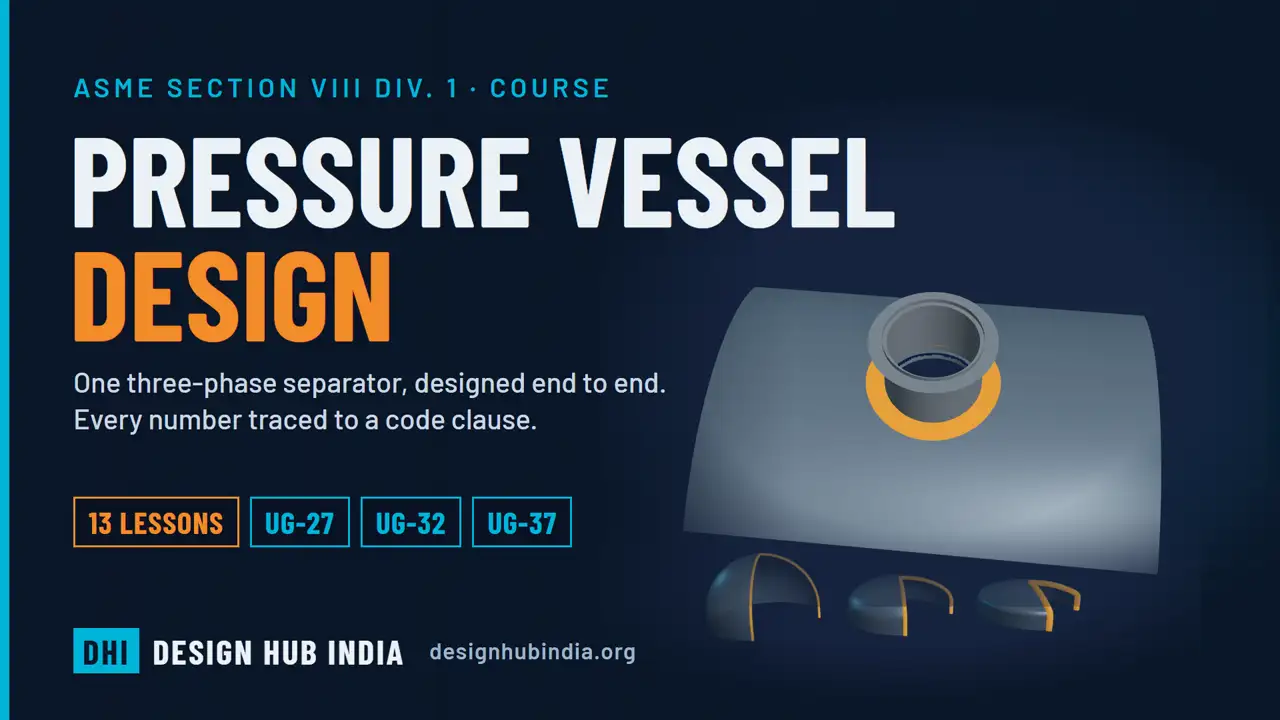
Design a real pressure vessel to ASME VIII Div. 1, from the design basis to the plate you order.
For mechanical and process engineers, students, and fabrication or QA staff who check vessel calculations.
13 video lessons · Certificate · 7-day refund · 74.6K learners on YouTube
YouTube figures from the public channel page, 22 Oct 2026.
One pressure vessel, designed end to end
Most courses explain formulas in isolation. Here you follow a single vessel through ASME Section VIII Division 1 the way it is done on real oil and gas EPC projects: from the design basis to the plate you order, the heads you buy and the nozzle pads you weld. Every number on screen traces to a calculation and a code clause, and the honest limits are stated, not hidden.
- Horizontal three-phase separator
- ID 1,800 × 6,000 mm T/T
- 15 barg + full vacuum
- 120 °C · MDMT −29 °C
- SA-516 Gr 70 · CA 3 mm
What you will calculate

The design basis: design pressure, MAWP and MDMT
15 barg design · MAWP 16.6 barg

Shell thickness under internal pressure
11.6 mm required → 16 mm plate
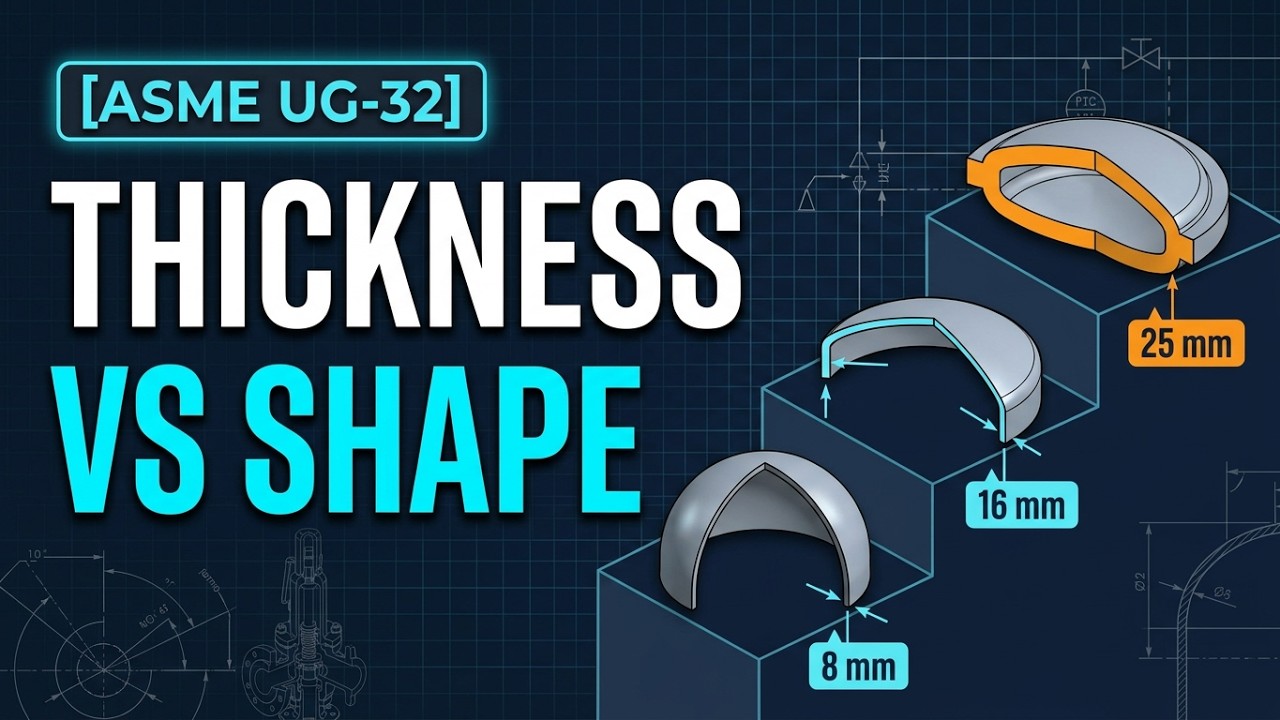
The heads: ellipsoidal vs torispherical vs hemi
Hemi 10 · 2:1 16 · F&D 25 mm

Nozzle reinforcement and the neck schedule
Pad Ø450 × 16 · +21 % spare
Watch Part 1 free
Why engineers trust these numbers
- Traced, not quotedEvery value comes from a calculation script and a named clause: UG-21, UG-27, UG-32, UG-37, UG-45.
- Honest limits on screenCompany practice is labelled as practice, assumptions are flagged, and you are told what to confirm against your code edition.
- Built like a real jobCorrosion allowance, mill tolerance, forming thinning and real plate sizes, not textbook round numbers.
- Visual, to scale3-D vessels, heads and nozzles drawn from the calculation, plus stress maps from the real formulas.
Course roadmap
- Parts 1–4 available now design basis, shell, heads, nozzle reinforcement
- Part 5: external pressure and stiffening rings UG-28, full vacuum
- Part 6: MDMT and impact test exemption UCS-66
- Part 7: joint efficiency, radiography and the hydrotest UW-11/12, UG-99
- Part 8: saddles, wind and seismic Zick method
- Plus 9 theory episodes design workflow, datasheets, nozzle schedules, supports, nozzle loads and PSV set pressure
New parts are added to this course as they are released.
Questions
What do I need to know before starting?
Basic engineering maths. Every code clause is explained in plain words and applied to one running example, a horizontal three-phase separator.
How long is the course?
13 video lessons, about 65 minutes today, plus long worked-example lessons (10 to 20 minutes each) being added through November.
Do I get a certificate?
Yes. When you complete the course you get a Design Hub certificate of completion that you can add to your CV and LinkedIn.
What is free and what is paid?
Parts 1 and 2 and theory Episode 1 are free to watch. Parts 3 and 4, the other theory episodes, the worked-example lessons and the certificate come with the course.
Which code edition do you use?
ASME Section VIII Division 1. Every number names its clause, and values you must confirm against your own edition (such as allowable stress) are flagged on screen.
Can I get a refund?
Yes. You can ask for a refund within 7 days of purchase. See the refund policy.
Keep learning
Course Content
Worked example: one separator, end to end (Parts 1-8)
-
03:15
-
03:02
-
Part 3: The heads, ellipsoidal vs torispherical vs hemispherical (UG-32)
03:02 -
Part 4: Nozzle reinforcement, UG-45 neck and UG-37 area replacement
02:15 -
Part 5: External pressure, full vacuum and stiffening rings (UG-28 / UG-29)
02:09 -
Part 6: MDMT and impact-test exemption (UCS-66 / UG-20(f))
02:32
Theory episodes (original series)
Earn a certificate
Add this certificate to your resume to demonstrate your skills & increase your chances of getting noticed.
Student Ratings & Reviews

