About Course
You get 10 MMSCFD of wet gas and a blank sheet. Before anyone buys a pipe, a process engineer makes 18 decisions, in order. This course makes them in order on one plant, the Design Hub Plant, and shows every step with its numbers, on paper and in 3-D.
9 of 18 lessons are made. Lessons 1 and 3 are free to watch now. The other lessons are listed below and added as each one is released.
A sample from Lesson 1
The plant’s mass balance, closed by hand. Three streams, two steps each: field units to a flow, then to kg/h.
| Stream | Field units | kg/h |
|---|---|---|
| Gas (SG 0.65) | 10 MMSCFD | 9,376 |
| Oil (SG 0.82) | 2,000 bbl/d | 10,864 |
| Water (SG 1.05) | 1,500 bbl/d | 10,434 |
| Total in = total out | 30,674 |
By mass, gas is only 31 % of what enters the separator. By actual volume at 12 barg, it’s 98 %. Rule: convert standard volume to mass before you size anything. Balance in kg/h. Size on actual volume.
Lessons 1 and 3 are free. Watch Lesson 1 and Lesson 3 now.
What you will be able to do
From the 9 lessons made so far:
- Write a design basis and close a plant mass balance in kg/h, from field units (MMSCFD, bbl/d).
- Set design pressure from maximum operating pressure, work out the MAWP from the plate thickness, and check the gap to the PSV set pressure.
- Build a heat and mass balance with normal, maximum and turndown cases, get a heater duty from m·Δh, and draw the PFD.
- Check for hydrates after every pressure drop, and size a heater on the case that actually governs.
- Size a separator’s gas space with Souders-Brown, and tell whether gas or liquid sets the diameter.
- Set a separator’s oil alarm and trip levels by time on the maximum live oil flow, and prove every gap in minutes.
- Check the momentum ρv² at a separator’s inlet and gas outlet nozzles at the maximum flow, and choose the inlet device.
- Choose the fail position of each control valve on a separator, and size its oil level valve on the choked drop.
- Run a HAZOP on one separator node, and credit only the safeguards on the P&ID that act in time.
- Then, as the lessons are released: pumps and NPSH, tanks, compressors and scrubbers, line sizing, shutdown, relief, blowdown and flare, materials and layout.
Who this course is for
- Graduate and junior process engineers who want to see a whole design, not one equation at a time.
- Mechanical, piping and instrument engineers who use process data every day and want to know where it comes from.
- Operations and commissioning engineers moving into design.
- Final-year chemical and petroleum engineering students.
You need: basic thermodynamics, comfort with units, and a calculator. Excel helps. You don’t need a process simulator: where a number comes from one, the lesson gives it to you and checks it by hand. (If you want the simulator side, our free HYSYS series simulates the same plant.)
One plant, start to finish
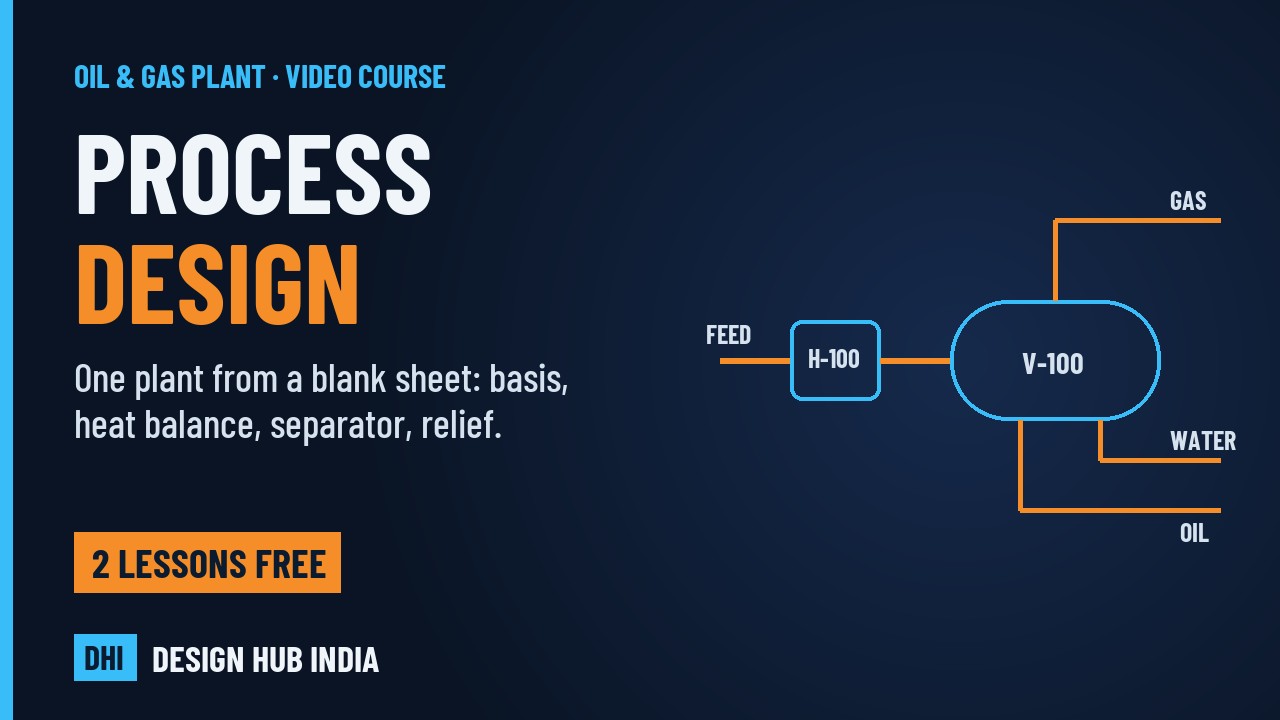
The Design Hub Plant is an early production facility: wells, a choke and line heater, a three-phase separator (V-100, 1.8 m × 6 m), an oil pump and tank, a gas compressor and scrubber, and a flare. It’s a teaching plant, not a real project, and it’s the same plant you see in our P&ID, pressure vessel, instrumentation, piping and CFD series. So when a lesson sets a number, you can see where it’s used next.
The plant’s design basis is free on one page. Read it before Lesson 1.
The 18 lessons
9 lessons are made: Lessons 1 to 5 with video (about 47 minutes), and Lessons 6, 7, 12 and 18 as written worked lessons with their calcs. Lessons 1 and 3 are free now. New lessons are added as each episode is released. Titles of planned lessons may change.
- Lesson 1. Oil & Gas Process Design: Full Worked Example: the design basis and the plant mass balance (13:43 · free preview)
- Lesson 2. Design Pressure vs MAWP: Set a Design Basis in 3 Steps: the pressure ladder, design pressure, MAWP and the PSV gap (9:26 · included)
- Lesson 3. Heat and Mass Balance to PFD: a 12-stream HMB with three cases, and the PFD (10:16 · free preview)
- Lesson 4. Why Chokes Freeze: Hydrates and Heater Duty: the hydrate check across the choke and the heater’s design duty (5:57 · included)
- Lesson 5. Separator Gas Sizing: Souders-Brown Worked Example: the gas capacity check, and why the liquid sets V-100’s diameter (7:10 · included)
- Lesson 6. 3-Phase Separator Design: Retention Time and Levels: retention time and the level stack (written worked lesson · included)
- Lesson 7. Separator Nozzles: Inlet Devices and Momentum: nozzle sizing and the inlet device (written worked lesson · included)
- Lesson 8. Pump Sizing and NPSH: Worked Example: the export pump and its NPSH margin (planned)
- Lesson 9. Storage Tank Design: Venting and Size: tank size and venting (planned)
- Lesson 10. Gas Compressor and Scrubber Design: the compressor and its suction scrubber (planned)
- Lesson 11. Line Sizing for a Whole Plant: Criteria and Line List: line sizing criteria and the line list (planned)
- Lesson 12. Control Philosophy: 3 Loops That Run a Separator: the control loops, their fail positions and the oil level valve sized (written worked lesson · included)
- Lesson 13. Shutdown vs Control: SIS and Cause & Effect: the shutdown system and the cause and effect chart (planned)
- Lesson 14. Relief Scenarios and PSV Sizing (API 521): relief scenarios and the PSV size (planned)
- Lesson 15. Blowdown and Flare Design: depressuring and the flare (planned)
- Lesson 16. Material Selection and Corrosion Allowance: materials and corrosion allowance (planned)
- Lesson 17. Plot Plan and Equipment Layout: where the equipment sits, and why (planned)
- Lesson 18. HAZOP Study Example: 10 Deviations on One Separator: a 10-row HAZOP of V-100 and its outlets (written worked lesson · included)
What every lesson gives you
- The full video (6 to 14 minutes) in Lessons 1 to 5. Lessons 6, 7, 12 and 18 are written worked lessons with no video today.
- Lesson notes: inputs, the method with its source, and the worked steps with every number.
- The common mistake (“red pen”) and the rule to take away.
- Lessons 1 to 5 end with a practice question, its worked answer and a short written quiz. Worked lessons end with 3 check questions and their worked answers.
Questions
Are the videos on YouTube already?
Some are public on the DesiGn HuB channel, and some are for channel members. The course puts all 18 in order and adds the lesson notes and practice questions.
Which codes and methods does it use?
Each lesson names its source on screen and in the notes, for example ASME VIII Division 1 UG-27 for shell thickness, ASME B16.5 for flange ratings, Peng-Robinson for the flash, and GPSA for separator gas capacity. Company practice is marked as company practice, not code.
Is the plant a real project?
No. It’s a generic teaching plant, with realistic numbers. No client data is used.
Do I need HYSYS or another simulator?
No. The sizing steps are worked by hand. Where a lesson uses simulator results (the heat and mass balance, the choke temperature), it shows them and checks them by hand.
How many lessons are ready?
9 of 18 are made today; 1 and 3 are free to watch.
What does it cost?
The current price is shown on this page. Pay once and keep the course. 9 of 18 lessons are live now; every later lesson is included as it is released.
When will all 18 lessons be ready?
A new lesson is added as each episode is released. The lesson list above always shows what’s live.
What language are the lessons in?
English, with every term explained the first time it’s used.
Is there a certificate or a downloadable calc sheet?
Certificate of completion when the full course is released and finished. It is not an accreditation, licence or professional qualification. There is no downloadable calc sheet today. The course is the videos, the lesson notes and the practice questions. If more is added, this page will say so.
Can I watch on my phone?
Yes. The lessons play on phone, tablet and desktop. The worked steps are easier to follow on a bigger screen.
Start free
Watch Lessons 1 and 3 first. Also free: the free design basis, the free tools in Design Hub Labs, and the HSep+ separator designer (sign-in needed).
Course Content
The Design Hub Plant, decision by decision (18 lessons)
-
13:43
-
Lesson 2 · Design Pressure vs MAWP: Set a Design Basis in 3 Steps
09:26 -
10:16
-
Lesson 4 · Why Chokes Freeze: Hydrates and Heater Duty
05:57 -
Lesson 5 · Separator Gas Sizing: Souders-Brown Worked Example
07:10 -
Lesson 6 · 3-Phase Separator Design: Retention Time and Levels
-
Lesson 7 · Separator Nozzles: Inlet Devices and Momentum
-
Lesson 8 · Pump Sizing and NPSH: Worked Example (coming soon)
-
Lesson 9 · Storage Tank Design: Venting and Size (coming soon)
-
Lesson 10 · Gas Compressor and Scrubber Design (coming soon)
-
Lesson 11 · Line Sizing for a Whole Plant: Criteria and Line List (coming soon)
-
Lesson 12 · Control Philosophy: 3 Loops That Run a Separator
-
Lesson 13 · Shutdown vs Control: SIS and Cause & Effect (coming soon)
-
Lesson 14 · Relief Scenarios and PSV Sizing (API 521) (coming soon)
-
Lesson 15 · Blowdown and Flare Design (coming soon)
-
Lesson 16 · Material Selection and Corrosion Allowance (coming soon)
-
Lesson 17 · Plot Plan and Equipment Layout (coming soon)
-
Lesson 18 · HAZOP Study Example: 10 Deviations on One Separator
Student Ratings & Reviews